¶ Assessments
Assessments are essential tools used to evaluate employees' knowledge, skills, and competencies in a specific subject matter. These can be in the form of quizzes, tests, or practical evaluations, helping organizations make informed decisions and enhance employee development.
¶ Why Are Assessments Important?
Assessments serve multiple purposes, including:
- Evaluating Knowledge: Determine how well employees understand specific topics or skills.
- Identifying Gaps: Find areas where employees need additional training or development.
- Tracking Progress: Monitor improvements in employee performance over time.
- Making Informed Decisions: Use results to guide promotions, training programs, and resource allocation.
- Ensuring Competency: Verify that employees meet job requirements and company standards.
¶ Types of Assessments
¶ 1. Preference Assessments
Purpose: Identify an individual’s work style, task preferences, and ideal work environment.
Components:
- Questions related to preferred work environments (e.g., quiet vs. collaborative).
- Preferences for task types (e.g., analytical vs. creative).
- Interaction styles (e.g., independent vs. team-oriented).
Benefits:
- Aligns employees with roles that suit their natural inclinations.
- Enhances job satisfaction and productivity by matching employees with compatible work environments.
- Helps in personalized career development based on preferences.
Structure:
- Employees receive a set of instructions before starting the assessment.
- The assessment consists of 102 questions on different preferences.
- Employees gain insights into their strengths, weaknesses, and work style.
¶ 2. Potential Assessments
Purpose: Measure an individual's ability to learn, adapt, and grow within the organization.
Components:
- Evaluations of cognitive abilities, problem-solving skills, and learning agility.
- Situational questions assessing adaptability to change and leadership potential.
Benefits:
- Identifies high-potential employees for leadership roles.
- Ensures a strong talent pipeline for future growth.
- Helps in targeted training and succession planning.
Structure:
- Employees receive a set of instructions before starting.
- The assessment consists of 17 scenario-based questions, requiring users to select one option.
- Results provide insights into future leadership and development opportunities.
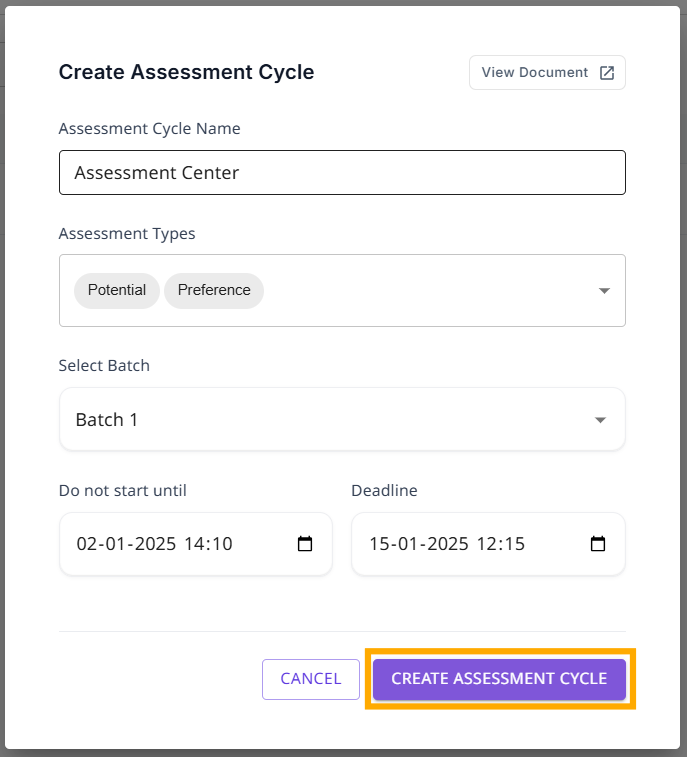
¶ How to Create an Assessment Cycle
Creating an assessment cycle ensures a structured evaluation process. Follow these steps:
-
Enter Assessment Cycle Name
- Provide a unique name for the assessment cycle.
-
Select Assessment Type
- Choose between Preference Assessments or Potential Assessments.
-
Select Batch
- Assign the assessment to a specific group of employees.
-
Set Start Date
- Specify when the assessment should begin.
- Format: dd-mm-yyyy --:--
-
Set Deadline
- Define the final date for completing the assessment.
- Format: dd-mm-yyyy --:--
-
Save Changes
- Click on the Click Create Assessment Cycle button to save your modifications.